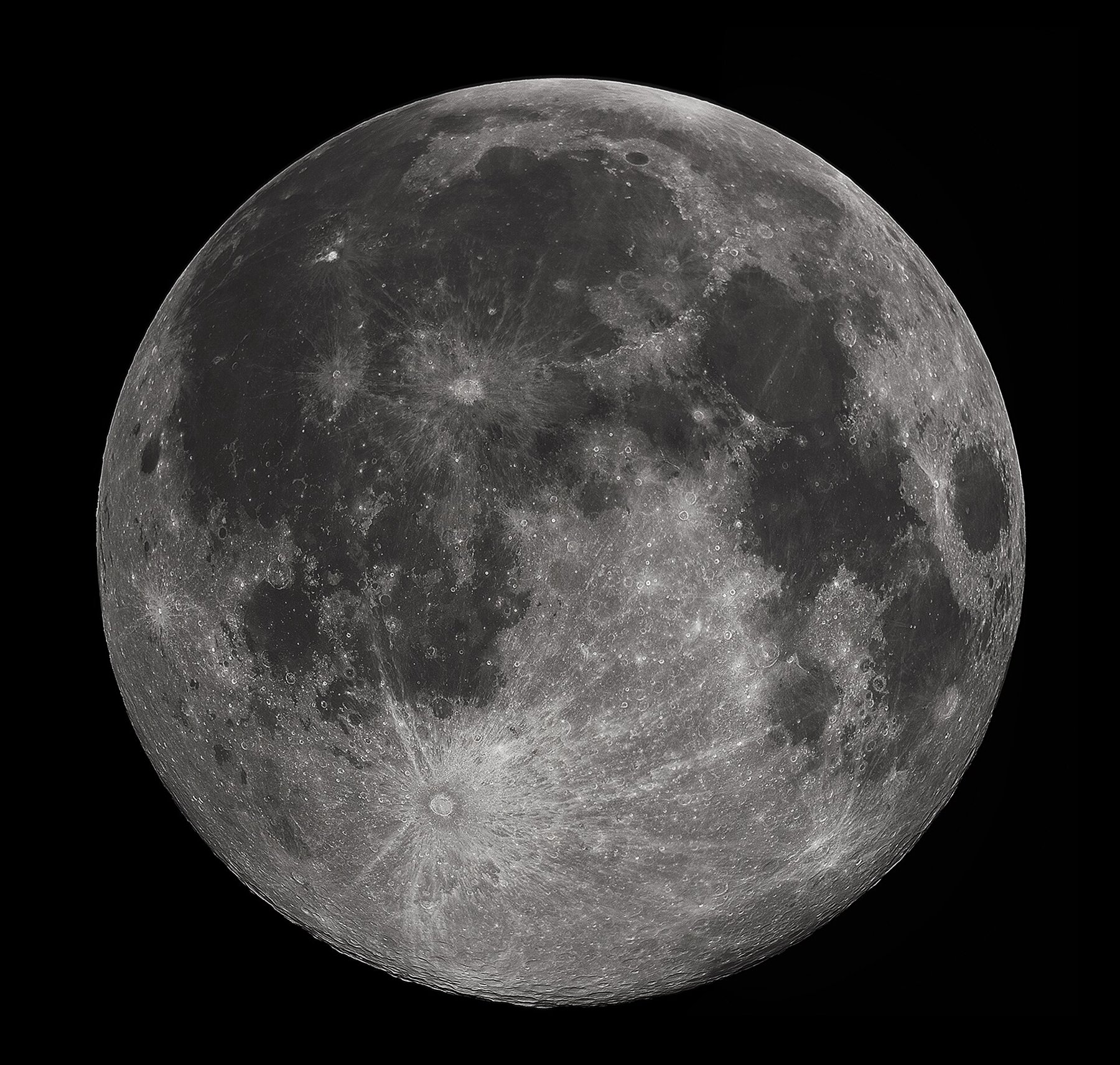
The Moon sits in a dark sky but is often surprisingly bright itself. Metering that includes a large area of black sky may therefore produce an overbright lunar disc. First decide whether you want surface detail or the Moon as part of a landscape. These two tasks often require different choices of focal length, timing and exposure.
Judge the surface rather than the sky
Make a test frame and enlarge the lunar disc. If bright areas lack structure, reduce exposure. For example, use manual exposure and adjust shutter speed while initially keeping aperture and ISO constant. A dark overall histogram is normal for this subject and is no reason to raise the sky to middle grey.
A longer focal length makes the Moon larger but increases demands on support and accurate focus. Use firm support and release without unnecessary contact. Check the stabilization setting for the lens and support method. Wind or yielding ground can transmit movement even through a tripod.
Separate focus from atmosphere
Focus on a clear lunar edge or visible structure and inspect the enlarged result. The infinity stop is not the exact setting on every lens. Check again after accidentally touching the focus ring during adjustment. If detail varies between soft and wavering across several frames, turbulent air may contribute. Constant refocusing does not necessarily solve that effect.
A higher Moon is viewed through less low-level atmosphere than one near the horizon. Warm roofs or an open window may also affect the line of sight. Compare an unobstructed position and several short exposures. Oversharpening cannot turn atmospherically blurred detail into reliably recorded craters.
Combine the Moon with a landscape
At twilight, landscape and Moon may have more similar brightness than in full darkness. Plan timing and viewing direction first. If you combine separate exposures, identify that treatment where the image might be understood as documentation. Keep size and position plausible; an arbitrarily enlarged Moon changes the scene being represented.