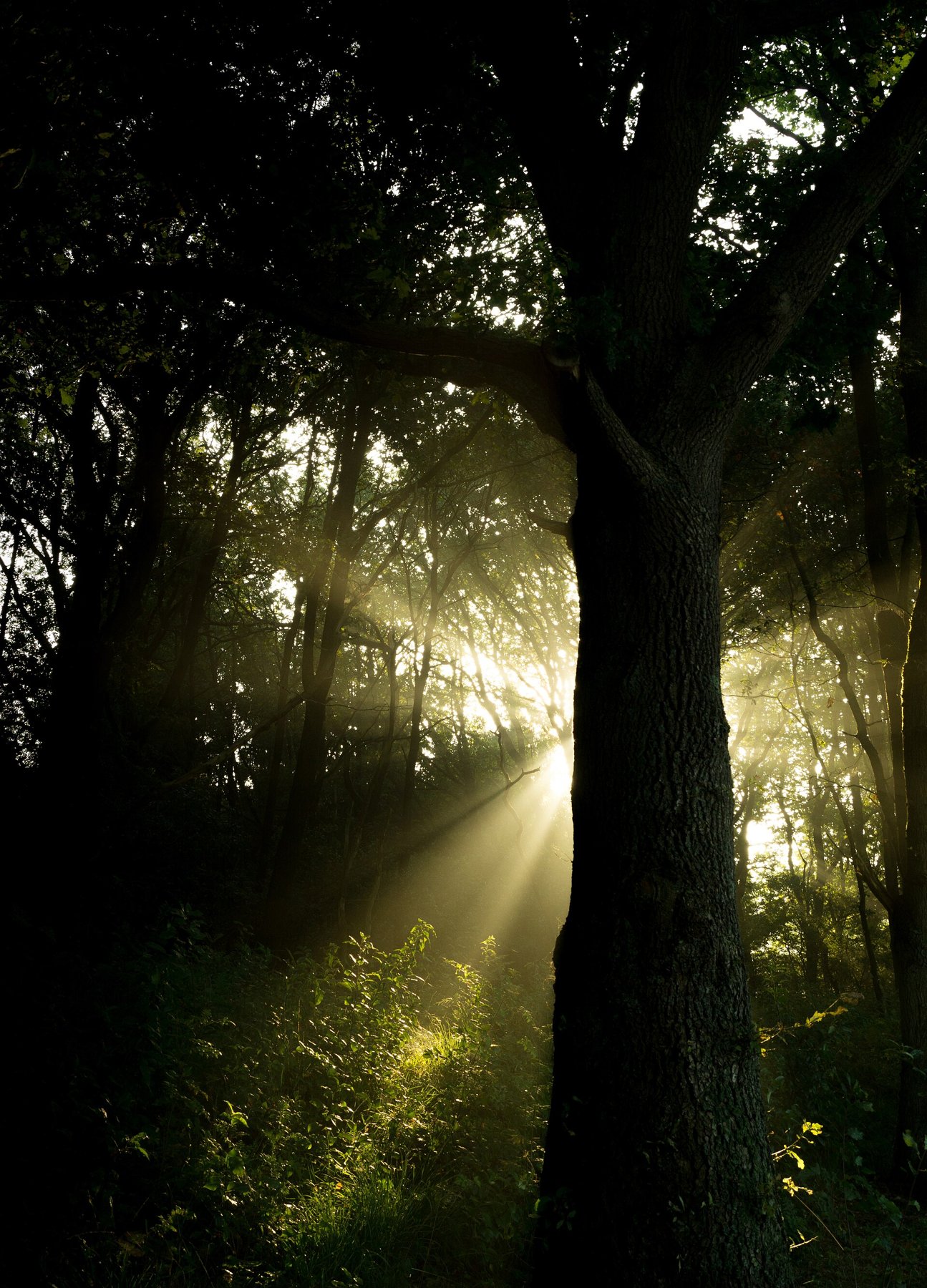
A forest can feel spacious and calm in person yet become a tangle of branches in a photograph. Our eyes automatically find routes through depth; a flat image needs clearer relationships. First find a patch of light, a distinctive trunk or a repeating shape. Build the framing around that element rather than trying to show every tree at once.
Organize patches of light
Direct sun creates small bright areas among dark ones. One illuminated trunk can stand out clearly; many scattered patches can fragment attention. Move a few steps and check whether the main subject separates from a quieter background. The brightest patch should not sit accidentally at an edge if it serves no purpose.
Under an overcast sky, transitions are often more even. This suits bark, moss and leaf textures. Tighter framing can then show different surfaces without including a blank white sky. After rain, wet areas may reflect strongly; decide whether that shine explains form or obscures colour.
Depth without confusion
Watch overlaps between trunks. A small sideways step can separate two trees that previously looked like one broad trunk. Foreground does not need to be extremely close. A blurred branch near the camera can suggest depth but can equally obscure the main subject. Check its shape in the finished framing.
A longer focal length can isolate an organized part of the scene. Choose it not only to enlarge distant things but to exclude distracting edges. A path or stream can provide direction without always occupying the centre. Let lines lead towards a readable area rather than leave the frame without a meaningful destination.
Expose for important surfaces
Check bright leaves and bark for retained detail. Deep shadows can stay dark when they support the lighting. During long tripod exposures, leaves may blur in wind while trunks remain sharp. Decide whether that suits the mood. If fine leaf texture matters, shorten exposure and accept higher ISO when necessary. Deep depth of field alone does not guarantee still details.