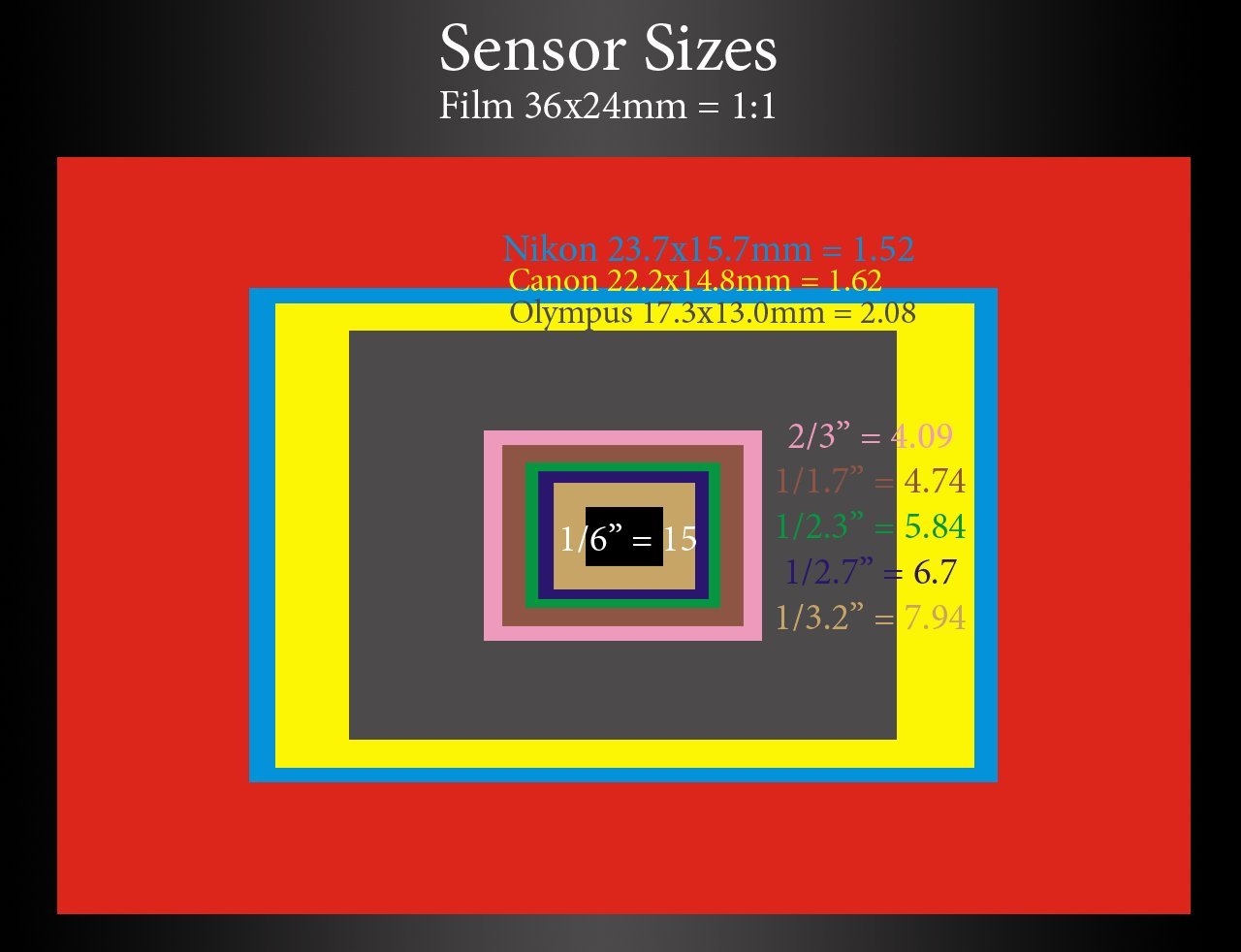
A 50 mm lens remains a 50 mm lens when mounted on a camera with a smaller sensor. The smaller sensor records less of the projected image circle, however, so the visible framing becomes tighter. This distinction explains why focal-length figures can create misleading expectations across camera systems when sensor format is not specified.
A common comparison
Full-frame-equivalent focal length describes angle of view relative to the traditional 35 mm format. With a crop factor of 1.5, a 35 mm lens provides approximately the angle of view of a 52.5 mm lens on full frame. Multiply actual focal length by crop factor. The calculation describes framing, not extra optical magnification supplied by the sensor.
Not every smaller sensor has the same factor. Even different APS-C systems can differ. Use the relevant camera manufacturer’s specification. Phones often quote an equivalent focal length already, while their actual optical focal length is much shorter. Do not multiply an already converted figure again.
What stays unchanged when format changes
From the same viewpoint, perspective relationships between objects stay unchanged even when a smaller sensor cuts off the edges. If you step backwards to restore the same framing, perspective changes because of the new position. That is often wrongly attributed to the sensor alone. Always compare viewpoint and framing together.
A lens’s f-number also does not change with a smaller sensor. However, matching depth of field at the same framing, viewpoint and output size requires a separate equivalence comparison. An identical f-number across differently sized formats does not automatically mean identical background blur. Comparing angle of view and comparing depth of field are different tasks.
What a crop actually compares
Suppose a smaller-sensor camera records a narrower view with a 50mm lens than a full-frame camera using the same lens. Crop the full-frame image to the same area and perspective will match if the viewpoint was identical. The files need not contain the same amount of detail, however: that depends on pixels within each crop, lens performance and capture conditions. The original total megapixel count cannot answer the question alone.
For a fair screen comparison, bring both results to the same output size. Viewing one at one hundred percent and the other fitted to the window may compare different magnifications. Noise, camera shake and small focus errors then become visible to different degrees. Record whether you are judging equal framing, an equal pixel view or equal print size.
Lens choice also depends on the goal. A smaller sensor with the same focal length may be convenient for a narrow view. A wide interior view requires a correspondingly shorter focal length. Neither observation automatically means higher quality; it initially describes which part of the scene each system records.
Framing is not resolution
Tighter framing can distribute a distant subject better across the picture, but it does not guarantee more detail. Pixels on the subject, lens performance, focus and movement all matter. An in-camera crop mode uses only part of the sensor and often reduces the saved pixel count. Before a large print, check actual file dimensions rather than assuming the crop factor provides extra resolution. For a simple comparison at home, make two rectangular crops from the same file. The smaller crop illustrates a tighter field of view, but it does not demonstrate differences in noise or sensor technology. Those properties cannot be inferred from a comparison of frame sizes alone.